
Finland´s new icebreaker advances to tender
A next-generation icebreaker design proven for changing Baltic winters – high performance, lower lifecycle cost, future-ready.
Read moreMEDIUM-CLASS ICEBREAKER

Medium-class icebreaker (B+)
Concept design, Tender design, Ice model tests, Open-water model tests, Manoeuvring tests, Seakeeping tests, Mariner workshops
2025–2026
Finnish Transport Infrastructure Agency
About 96 m (incl. towing notch) x 24 m x 7–8 m (icebreaking draught)
Twin shaftlines with an azimuthing bow propulsion unit; about 10.5 MW
Model tests: over 8 knots in 80 cm level ice, over 9 knots in 60 cm level ice; continuous motion in 1.5 m level ice
Icebreaker (Escort), Ice Class PC5 (plus)
Railotech (formerly Aker Arctic) has been developing a new medium-class icebreaker for the Finnish Transport Infrastructure Agency since April 2025. The vessel will replace Voima, Finland’s only B-class icebreaker, in service since 1954. Its main task is to assist commercial vessels calling at Finnish ports in winter, at a significantly lower operating cost than the larger A-class icebreakers. It will work in the Bothnian Bay in early winter and move to the Bothnian Sea or the Gulf of Finland as conditions intensify.
Railotech developed three outline design alternatives, and two were progressed to tender-level design. As the vessel has a planned service life of more than 50 years, all alternatives went through an extensive model-testing programme: ice model tests, open-water tests, manoeuvring tests and and, for one concept, seakeeping tests. This allowed a reliable comparison of performance, operability and 50-year lifecycle cost.
The hull reflects changing Baltic winters. Seven of the past ten winters have been classified as mild, so the vessel is more likely to meet dynamic, fragmented ice than stable landfast ice. The bow is sharper and more wedge-shaped than on traditional icebreakers designed for thick unbroken ice. The hull is also streamlined for open-water efficiency, high-speed convoy operations and reduced slamming. Both tender concepts have an azimuthing propulsion unit in the bow for agility in assistance work. The selected configuration combines it with twin shaftlines at the stern, which meets the Agency’s operational requirements and offers significant long-term cost savings.
Model tests show speeds above 8 knots in 80 cm level ice and above 9 knots in 60 cm ice, clearly exceeding the initial requirements. The power plant is based on proven technology and is future-proofed for methanol, with a battery energy storage system and waste-heat recovery. Workshops with professional mariners shaped the wheelhouse, machinery spaces, accommodation and, most importantly, the towing arrangement.
The Agency has selected Helsinki Shipyard to build the vessel. The construction of the new icebreaker is set to begin in 2027 with delivery scheduled for September 2029.
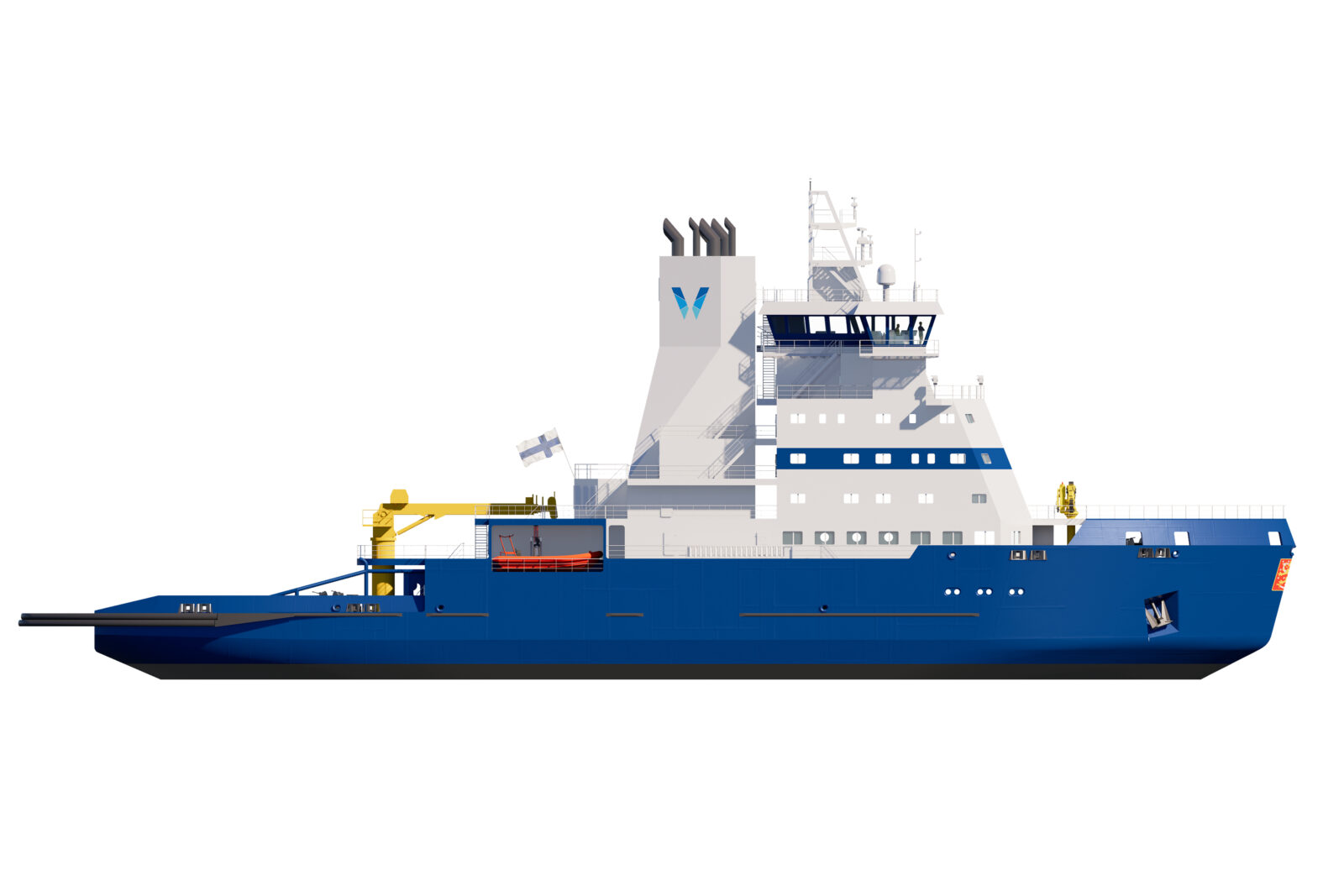
The concept featuring twin shaftlines and an azimuthing bow propulsion unit was shown in the concept design study to be more affordable but still very capable. The azimuthing bow propulsion unit provides high agility and excellent performance in brash ice.
Lauri Kuuliala
Finnish Transport Infrastructure Agency
A next-generation icebreaker design proven for changing Baltic winters – high performance, lower lifecycle cost, future-ready.
Read more
Aker Arctic began the concept design of a new medium-class icebreaker for the Finnish Transport Infrastructure Agency in April…
Read more